Why The Fed Rate Hike Fails To Fix Targeted Inflation
ZeroHedge ·
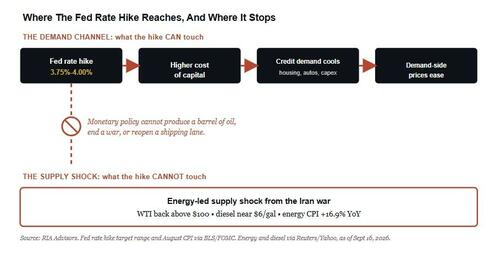
In a unanimous decision, the FOMC lifted the federal funds rate target range by 25 basis points to 3.75%-4.00%, marking the first rate hike since 2023 under the banner of price stability. However, the move was largely forced by the bond market, as the 10-year Treasury yield surged to approximately 5.01%, a 19-year high, while the 30-year yield surpassed 5.35%. Rate hikes operate strictly through a demand-side mechanism, raising borrowing costs to cool credit-dependent sectors like mortgages, auto loans, and corporate capital expenditures. Yet, critics note that tighter monetary policy fails to address supply-side pressures or structural inflation drivers that remain completely outside the central bank's direct control.
AI 시장 분석
The U.S. Federal Reserve raised interest rates by 0.25%p, bringing the benchmark rate to 3.75%-4.00%, while the 10-year Treasury yield hit 5.01%. Although driven by bond market pressure, monetary tightening only induces demand slowdowns without resolving supply-side inflation. Investors must face the limits of monetary policy and closely examine the economic fallout from rising financing costs.
상승 영향
- Banks — Base rate hikes and rising Treasury yields expand loan-deposit spreads and improve net interest margins (NIM), which can enhance short-term profitability.
하락 영향
- Real Estate — Surging borrowing costs like mortgage rates reduce purchasing power, depressing transaction volume and demand in the real estate market.
- Growth Stocks — Higher discount rates lower the present value of future cash flows and increased financing costs burden corporate valuations.
- Bonds — Rate hikes and soaring Treasury yields (10-year hitting 5.01%) depress existing bond prices, increasing asset loss pressure.
DYAX 전담 분석
The Fed's 25bp rate hike and the 10-year Treasury yield reaching a 19-year high comprehensively raise financing costs, rapidly cooling credit-based demand. Mortgages, auto loans, and corporate capital expenditures take a direct hit, increasing the risk of weakening overall economic growth momentum.
The bullish scenario is that the rate hike stabilizes inflation expectations and induces a soft landing, while the bearish scenario is that excessive tightening triggers a recession amidst persistent supply-driven inflation. Key indicators to watch include the future trajectory of the 10-year Treasury yield and delinquency rates for housing and auto loans.
AI가 생성한 분석으로 투자 자문이 아닙니다.
DYAX Investor Sentiment
Bullish (Long) 51% · Bearish (Short) 49%
447 participants
Related News
- Minneapolis Fed President Kashkari Says Inflation Remains Too High
- Good Intentions Paved The Road To The 2008 Financial Crisis
- Trump Scraps Arc de Triomphe Project in Favor of Drone Facility
- Analyzing Federal Reserve Officials' Stances on the September 2026 Dot Plot
- What to Expect from the Trump-Xi Jinping Summit
- US and China Set to Negotiate AI, Tariffs, and Critical Minerals Ahead of Summit
