Global Food Prices Hit 2022 Highs as Perfect Storm Triggers Fresh Inflation Fears
ZeroHedge ·
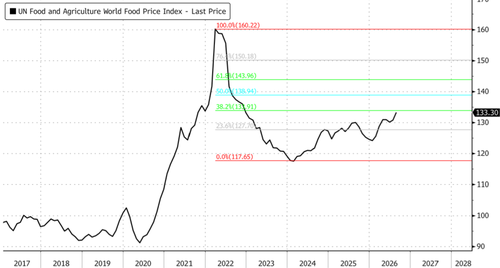
The United Nations Food and Agriculture Organization announced that its global food-commodity index climbed to 133.3 in August, marking its highest level since 2022 and rising 1.9 percent from July with gains across all major categories. Sugar prices surged by 11.9 percent, while wheat advanced 2.6 percent to sit 15 percent higher than year-ago levels. A convergence of adverse factors, including El Nino weather patterns, elevated fertilizer and diesel expenses, and logistical disruptions in the Black Sea and the Strait of Hormuz, is threatening the global food supply. Furthermore, the Bloomberg Agriculture Spot Index posted its largest monthly jump since the Arab Spring riots, nearing a breakout above 2023 highs. As agricultural markets tighten and diesel reaches record prices, renewed inflationary pressures are rippling through global supply chains while central banks evaluate their monetary stance.
AI 시장 분석
The FAO World Food Price Index for August recorded 133.3, hitting its highest level since 2022 and adding to inflationary pressures. As prices of major commodities such as sugar and wheat surge, price hike shocks are spreading across global supply chains. Investors should monitor the negative impact that the surge in agricultural prices will have on national monetary policies and consumer goods corporate profitability.
상승 영향
- Commodities — The FAO Food Price Index recorded 133.3, the highest since 2022, driving the upward trend in agricultural prices.
하락 영향
- Consumer Goods — Cost burdens are increasing due to soaring food prices such as sugar and wheat, raising concerns over the deterioration of profitability for related companies.
- Stock Market — As the food inflation shock spreads through global supply chains, expectations for additional rate cuts by central banks are weakening.
DYAX 전담 분석
The rise in global agricultural prices, with the FAO Food Price Index up 1.9% month-on-month and sugar surging 11.9%, leads to increased cost burdens and compresses margins for consumer goods companies. This acts as an inflation-triggering factor that could brake central banks' interest rate cut paths.
In the bullish scenario, prolonged supply disruptions benefit agricultural and commodity-related stocks, while in the bearish scenario, persistent high inflation leads to reduced consumption and delayed rate cuts, increasing downward pressure on valuations across the stock market. Key monitoring indicators are the FAO Food Price Index and agricultural spot indices.
AI가 생성한 분석으로 투자 자문이 아닙니다.
DYAX Investor Sentiment
Bullish (Long) 51% · Bearish (Short) 49%
331 participants
Related News
- Iranian FM Departs Tehran for UN Assembly with Planned Stop in Qatar
- Newsquawk Daily Asia-Pac Opening News - 21st September 2026
- Tungsten Shines in Resource Wars as Western Rearmament Sparks Supply Chain Push
- Iranian Military Asserts US Is Preparing to Renew Attacks
- Utah Valley University Faculty Emails Regarding Charlie Kirk Revealed
- Market Decoupling After the Fed and Key Macro Themes
