Treasury 5-Year Auction Disasters Spawns Worst Bond Market Rout Since Liberation Day
ZeroHedge ·
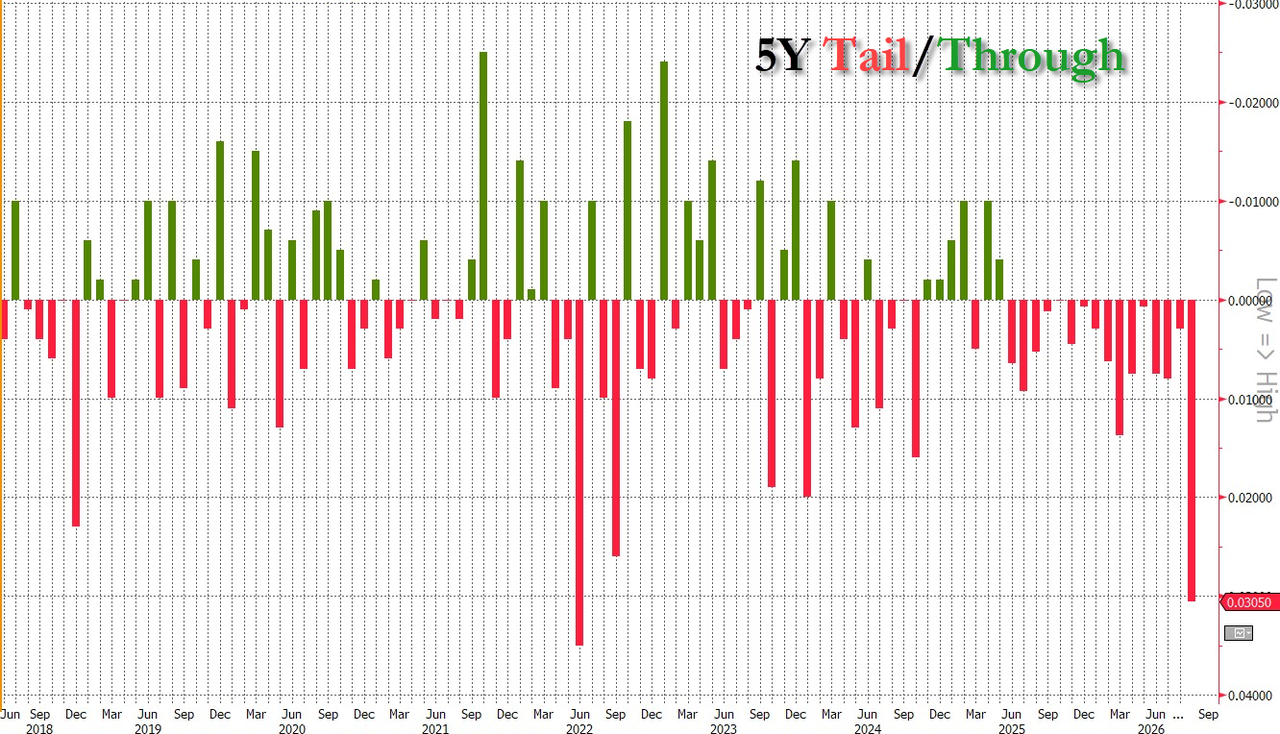
On September 23, 2026, the $70 billion five-year Treasury auction concluded with disastrous results, triggering a severe sell-off across the bond market. Heading into the sale, yields had already jumped by 15 basis points to 4.99%. Ultimately, the debt priced at a yield of 5.033%, crossing the 5% threshold for the first time since 2007. The auction tailed by a massive 3.1 basis points compared to the when-issued trading at 5.001%, marking the second-largest tail on record. Demand proved remarkably weak, as the bid-to-cover ratio dropped to 2.212, the lowest since December 2018. Indirect bidders took only 54.31%, a low not seen since March 2020, forcing dealers to absorb 15.8%. Consequently, the 10-year yield surged near 5.13%, heading toward the worst single-day performance for bonds since Liberation Day.
AI 시장 분석
The $70 billion 5-year Treasury auction conducted by the U.S. Department of the Treasury suffered a dismal failure due to weak demand, issuing at the highest yield in 19 years at 5.033%. This auction failure caused a sharp decline in the bond market, with the 10-year Treasury yield surging to nearly 5.13%. Investors should exercise caution regarding increased borrowing costs and heightened stock market volatility stemming from the soaring Treasury yields.
상승 영향
- Banks — Expectations of improved net interest margins (NIM) due to soaring Treasury yields act as a short-term boost to profitability.
하락 영향
- Bonds — Yields skyrocketed following the disastrous 5-year Treasury auction, causing bond prices to plunge to historical lows.
- Real Estate — Mortgage rates rose in tandem with Treasury yields, exacerbating the contraction in housing demand and the burden of financing costs.
- Growth Stocks — As the risk-free Treasury yield exceeds 5%, the present value of future cash flows is discounted, increasing downward pressure on stock prices.
DYAX 전담 분석
The 5-year Treasury auction recorded a bid-to-cover ratio of 2.212, the lowest since 2018, along with a massive tail of 3.1 bps, demonstrating that the market's capacity to absorb bonds has reached its limit. A sharp decline in indirect bidding demand and an increase in dealer-taken supply led to a widespread sell-off across all maturities, adding to the burden on financial markets.
If the upward trend in interest rates continues, it could act as additional downward pressure on growth stocks and the real estate market. Investors must closely monitor the Federal Reserve's monetary policy stance and Treasury demand indicators.
AI가 생성한 분석으로 투자 자문이 아닙니다.
DYAX Investor Sentiment
Bullish (Long) 55% · Bearish (Short) 45%
314 participants
Related News
- NEC Director Hassett Emphasizes Path Forward for Fed Independence
- Mortgage Rates Hit Post-2024 Highs as Housing Demand Softens
- Goldman Sachs Expects Persistent Uncertainty Around Critical Minerals Tariffs
- ECB Chief Economist Assesses Wage Pressures as Still Limited
- More US Homebuyers Apply For Riskier Mortgages As Interest Rates Top 7%
- ECB's Lane Notes No Major Wage Response to Energy Shock Amid Policy Updates
