America Appears More Affluent Than Ever as Questions Mount Over the Fed's Asset Bubble
ZeroHedge ·
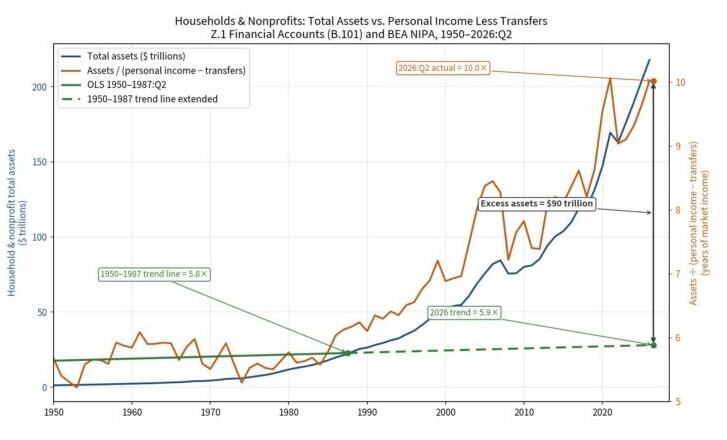
According to David Stockman, the FOMC and its aggressive monetary policies have severely distorted the financial landscape. Following 1987, the growth trajectory of household assets decoupled sharply from earned income. Between the 1950s and 1987, the asset-to-earned-income ratio remained remarkably stable, hovering around 5.8X by Q2 1987, compared to 5.4X in the early 1950s. However, due to the central bank's aggressive credit expansion, the actual ratio surged to 10.0X. Consequently, the household and nonprofit sectors currently hold a staggering $90 trillion more in total assets than historical pre-1987 trends would have suggested. While aggregate net worth has skyrocketed from nearly $11 trillion to $196 trillion since 1989, this massive accumulation stems primarily from the Federal Reserve's printing press rather than traditional savings and earned income growth.
AI 시장 분석
Due to the Federal Reserve's monetary policy and credit expansion, US household wealth has significantly outpaced growth in earned income, deepening the asset bubble. Since 1987, the ratio of household assets to earned income has surged from a historical 5.8X to the current 10.0X, creating an astronomical asset bubble amounting to 90 trillion dollars. This is driven by the Fed's money printing rather than actual savings or income growth, and a future bubble burst could deliver a massive shock to financial markets. Investors must closely monitor the overly inflated asset values and the Fed's policy risks.
하락 영향
- Real Estate — In an asset bubble environment where the household assets-to-earned-income ratio has soared to 10.0X due to the Fed's liquidity supply, a sharp downward correction in housing prices is inevitable upon rate hikes or liquidity tightening.
- Growth Stocks — Because household assets, including stock portfolios, have skyrocketed to 196 trillion dollars based on the Fed's credit expansion rather than earned income growth, the decline in the stock market will be very severe if the bubble bursts.
- Bonds — Excessive asset expansion and distortion of monetary policy will increase future inflationary pressures and credit risks, maximizing volatility in the bond market and potentially causing price declines.
DYAX 전담 분석
The Fed's prolonged low-interest-rate and credit expansion policies have caused household wealth to skyrocket from 11 trillion dollars in 1989 to a staggering 196 trillion dollars, far outpacing the growth rate of earned income. As asset prices diverge from the fundamentals of the real economy, downward pressure on the asset market as a whole will intensify in the event of monetary authorities changing interest rate policies or reducing liquidity.
In the bullish scenario, successive monetary easing by the Fed will support asset prices, but in the bearish scenario, the 90 trillion dollar asset bubble risks bursting, causing growth stocks and the real estate market to collapse. Investors should pay close attention to indicators of shifts in monetary policy stance and household debt growth rates.
AI가 생성한 분석으로 투자 자문이 아닙니다.
DYAX Investor Sentiment
Bullish (Long) 39% · Bearish (Short) 61%
468 participants
Related News
- Fed's Daly Signals Potential Rate Hikes, Rules Out Urgent October Action
- US President Trump Claims the Fed Keeps Interest Rates Artificially High
- Brazilian Senator Bolsonaro Ahead of Lula in New Quaest Poll Ahead of October 25 Runoff
- Yemeni Air Defences Report Downed Saudi Typhoon Jet
- Chilean State Miner CODELCO Sets November 5 Meeting to Address Production Discrepancies
- White House CEA Chair Acknowledges Weak Inflation Report and Defends BLS Data
