Global Bond Yields Surge to Multi-Decade Highs Across Major Economies
ZeroHedge ·
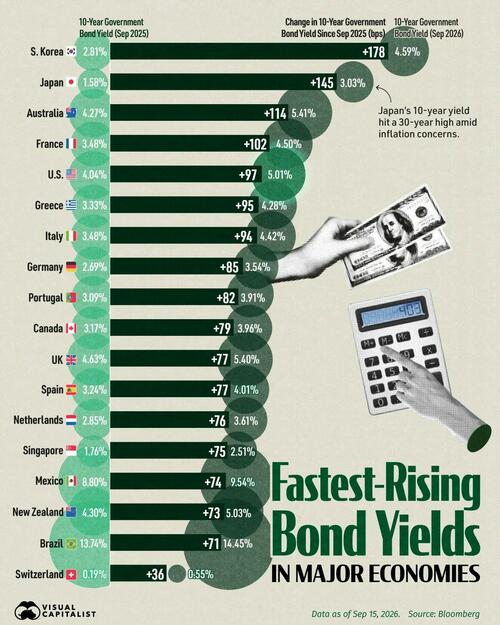
According to Bloomberg market data as of September 15, 2026, the 10-year U.S. Treasury briefly touched 5.04%, reaching its highest level since 2007. However, over the past twelve months, several nations have experienced even faster yield increases than the United States. South Korea led the surge with a remarkable 178 basis point jump, moving from 2.81% to 4.59%. Japan followed with a 145 basis point rise to 3.03%, while Australia and France recorded increases of 114 and 102 basis points, respectively, outpacing the U.S. gain of 97 basis points. Analysts note that these multi-decade highs in long-term borrowing costs are primarily driven by persistent inflation pressures fueled by energy prices, expanding government fiscal deficits, and investors demanding higher risk premiums for holding sovereign debt.
AI 시장 분석
As the US 10-year Treasury yield temporarily broke above 5% for the first time since 2007, long-term bond yields in major countries like South Korea (178bp) and Japan (145bp) are surging. This is the combined result of inflationary pressure from rising oil prices, massive government deficits, and increased government bond issuance. As global borrowing costs soar to multi-decade highs, it exerts heavy downward pressure on the asset market overall.
상승 영향
- Banks — As market interest rates surge across the board, net interest margins expand and interest income increases, which is positive for short-term earnings.
하락 영향
- Bonds — Rising interest rates (surging Treasury yields) directly trigger a drop in bond prices, diminishing the value of bond-held assets.
- Real Estate — Due to the soaring long-term government bond yields, mortgage and funding rates skyrocket, exerting strong downward pressure on real estate buying sentiment and asset prices.
- Growth Stocks — The present value of future cash flows plummets due to rising discount rates, directly hitting high-valuation growth stocks such as tech stocks.
DYAX 전담 분석
With the US 10-year Treasury yield hitting 5.04% and bond yields in major countries like South Korea and Japan rising steeply, falling bond prices and increasing funding costs are accelerating. This directly increases the interest burden on corporations and governments, acting as a factor that shrinks overall economic liquidity.
The bullish scenario is the inflow of bargain-hunting into bonds due to the perception of peak interest rates, while the bearish scenario is a breakout above interest rate ceilings caused by additional inflation concerns. Investors must carefully monitor future government bond issuance volumes and oil price trends.
AI가 생성한 분석으로 투자 자문이 아닙니다.
DYAX Investor Sentiment
Bullish (Long) 50% · Bearish (Short) 50%
448 participants
Related News
- Pretoria Seeks Strategic Bridge Between US and China Using Platinum Supply
- Japan Set to Relax Regional Bank Loan Caps for AI and Energy Initiatives
- Global Financial News Roundup: Swiss Deposits, Novo Targets, and ECB Bulletin
- ECB Bulletin Highlights Differing Pass-Through Rates for Wholesale Gas and Electricity Prices
- Kremlin Reports No Progress in Ukraine Talks Amid Regional Updates
- Pakistani Interior Minister Heads to Tehran for Bilateral Talks
