US Initial Jobless Claims Hold Steady Amid Growing Labor Market Vulnerability
ZeroHedge ·
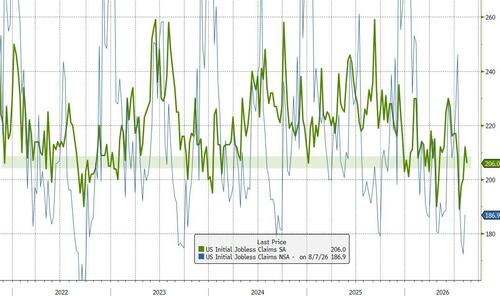
Initial jobless claims in the United States inched up to 206k last week, matching levels last seen in 2001, while continuing claims remained below the 1.8 million threshold. Michigan posted the steepest decline in initial filings, whereas Kentucky experienced the largest, albeit modest, increase. Despite this apparent resilience in headline jobless figures, broader economic indicators point to mounting fragility. Nonfarm payroll growth has dropped sharply, with July printing at -23k and pulling the three-month average down to roughly +20k. Furthermore, the unemployment rate edged down to 4.1%, but household surveys indicated declining labor force participation. Hiring and job openings have settled into a cautious low-hire, low-fire equilibrium. Meanwhile, second-quarter GDP growth decelerated to an annualized rate of 1.5% from 2.1% in the first quarter. This divergence indicates that while corporations are hesitant to lay off existing staff, they are equally reluctant to expand workforces amid weakening demand, leaving the overall employment landscape vulnerable.
AI 시장 분석
Initial jobless claims in the US remained near historical lows at 206,000 last week, but signals of overall labor market vulnerability are becoming clear, such as a slowdown in nonfarm payroll growth and a drop in Q2 GDP growth to 1.5%. Companies are maintaining a low-hiring and low-firing equilibrium by refraining from both layoffs and hiring, amplifying concerns over economic slowdown. Investors should pay attention to the underlying demand slowdown and potential shifts in the Federal Reserve's rate policy hidden behind employment indicators.
상승 영향
- Bonds — Expectations for rate cuts are maintained due to the overall slowdown in the labor market and the drop in GDP growth (1.5%), acting as a positive factor for bond prices.
- Growth Stocks — Signals of macroeconomic slowdown increase the possibility of a pivot to monetary easing by the Federal Reserve, creating a favorable environment for growth stock valuations.
하락 영향
- Stock Market — As nonfarm payroll growth plunges and Q2 GDP growth slows, concerns over worsening corporate earnings grow, acting as downward pressure on the stock market.
- Consumer Goods — Disposable income and consumer spending capacity are shrinking due to lower labor force participation and a cooling job market, leading to expected revenue slowdowns for related companies.
DYAX 전담 분석
Although initial jobless claims showed stability at 206,000, the average nonfarm payroll increase of only 20,000 and the slowdown in Q2 GDP growth to 1.5% directly suggest a weakening momentum in the real economy. Unlike the surface appearance of employment indicators, this shows that companies are avoiding hiring and demand is shrinking, increasing valuation burdens across the stock market.
The bullish scenario is a soft landing where consumption is defended by the maintenance of the low-layoff stance, while the bearish scenario is entering a rapid increase in unemployment and recession due to accumulated vulnerabilities. Key indicators to watch are upcoming continued jobless claims and revised nonfarm payroll figures.
AI가 생성한 분석으로 투자 자문이 아닙니다.
DYAX Investor Sentiment
Bullish (Long) 48% · Bearish (Short) 52%
529 participants
Related News
- SF Fed President Daly Views Bond Market as Key Monetary Policy Signal
- White House Focuses on Economic Pressure on Iran Over Military Escalation
- USTR Greer and Canadian Negotiators Set to Meet in Washington
- Mauritius Secures Long-Term Petroleum Supply Deal with India
- US Weekly Initial Jobless Claims Drop to 206K
- US 30-Year Bonds Reduce Advance Following Treasury Buyback Announcement
