US Labor Market Shows Low Hire and Low Fire Dynamics as Jobless Claims Hit 57-Year Lows
ZeroHedge ·
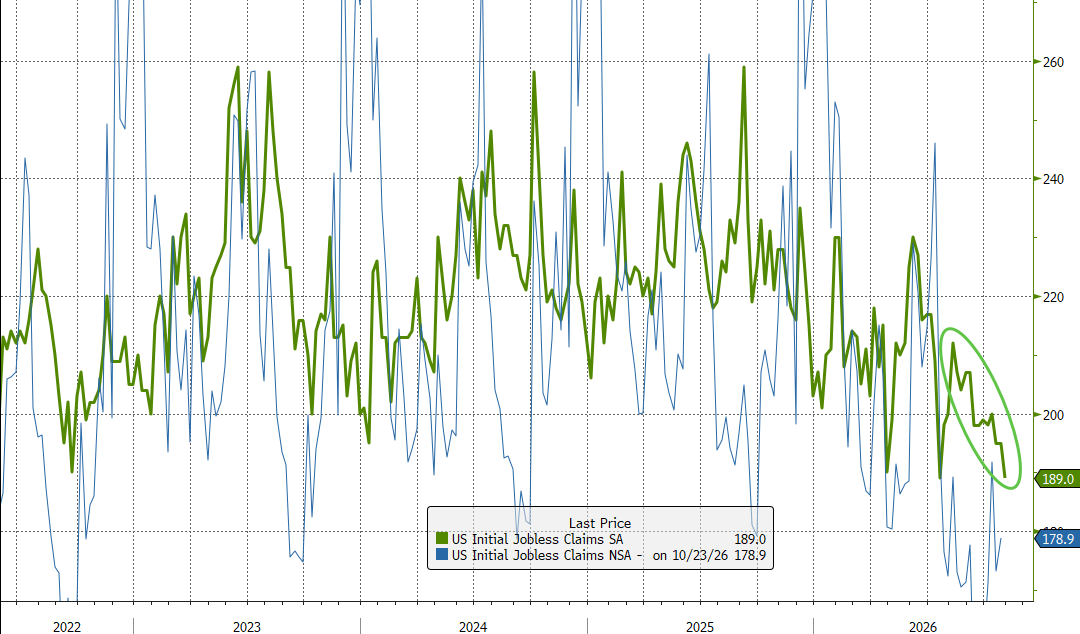
American employers continue to avoid significant layoffs, pushing initial jobless claims down to 189k this week, the lowest level since 1969. Continuing claims hovered around 1.7 million, confirming that the low-fire environment remains fully intact. However, the labor market remains trapped in a low-hire reality that has persisted for approximately three years. September JOLTS data indicated that job openings rebounded to 7.52 million with a 4.5 percent opening rate, but the hires rate remained stuck at 3.4 percent with roughly 5.4 million hires. Net payroll growth has stalled in the low-to-mid tens of thousands through most of 2026, creating a stagnant environment with limited worker mobility. Meanwhile, consumer sentiment remains depressed. The University of Michigan sentiment index closed October flat at 48.0, anchored by persistent purchasing power complaints and a year-ahead inflation expectation of approximately 4.7 percent. Although The Conference Board confidence index rebounded to 91.7 in October driven by lower gasoline prices, its expectations component stayed soft at 72.6, revealing ongoing worker anxiety.
AI 시장 분석
Initial jobless claims in the U.S. fell to 189,000, hitting a 57-year low since 1969, confirming a low-layoff trend without massive dismissals. However, the hiring rate stagnated at 3.4% and consumer sentiment remained low, continuing the decline in labor market dynamism. This low-hiring and low-motivation environment has complex effects on the Fed's rate policy and consumer goods market.
상승 영향
- Bonds — Although initial jobless claims hit a 57-year low of 189,000, the persistent decline in labor market dynamism and low hiring rate support expectations for Federal Reserve rate cuts, acting as a positive factor for bond prices.
하락 영향
- Consumer Goods — As the University of Michigan consumer sentiment index remains near historical lows at 48.0 and complaints about purchasing power rise, coupled with a low-hiring trend, it causes a decrease in household real income and a contraction in consumption.
DYAX 전담 분석
Initial jobless claims plummeted to 189,000, solidifying a low-layoff phase where companies are reluctant to cut staff. On the other hand, the hiring rate has stagnated at 3.4% for years and the University of Michigan consumer sentiment index remained at 48.0, as reduced purchasing power and inflation concerns slow down real economic dynamism.
The bullish scenario is that maintaining solid employment leads to moderate consumption, supporting a soft landing for the economy, while the bearish scenario is that low hiring and low wage growth directly lead to a consumption slump. Attention must be paid to upcoming non-farm payroll reports and inflation indicators.
AI가 생성한 분석으로 투자 자문이 아닙니다.
DYAX Investor Sentiment
Bullish (Long) 57% · Bearish (Short) 43%
269 participants
Related News
- Codelco is reportedly discussing lower copper premiums with some Chinese buyers, offering a premium of USD 268/tonne, Bloomberg reports
- China's Foreign Minister Wang says he hopes that the UK provides a favourable business environment for Chinese firms, according to Xinhua
- Venezuela projects around USD 160bln in oil-sector capex through 2036, comprising USD 85bln from partners and USD 75bln from PDVSA
- Iran oil ministry says 50% of damaged South Pars refinery capacity is back online, reports Irib
- Venezuela expects oil production to grow by 9.1% annually through 2036, reaching 2.9mln BPD, according to a government document
- US S&P/Case-Shiller Home Price (Sep YY) 2.6% vs. Exp. 2.7% (Prev. 2.6%)
